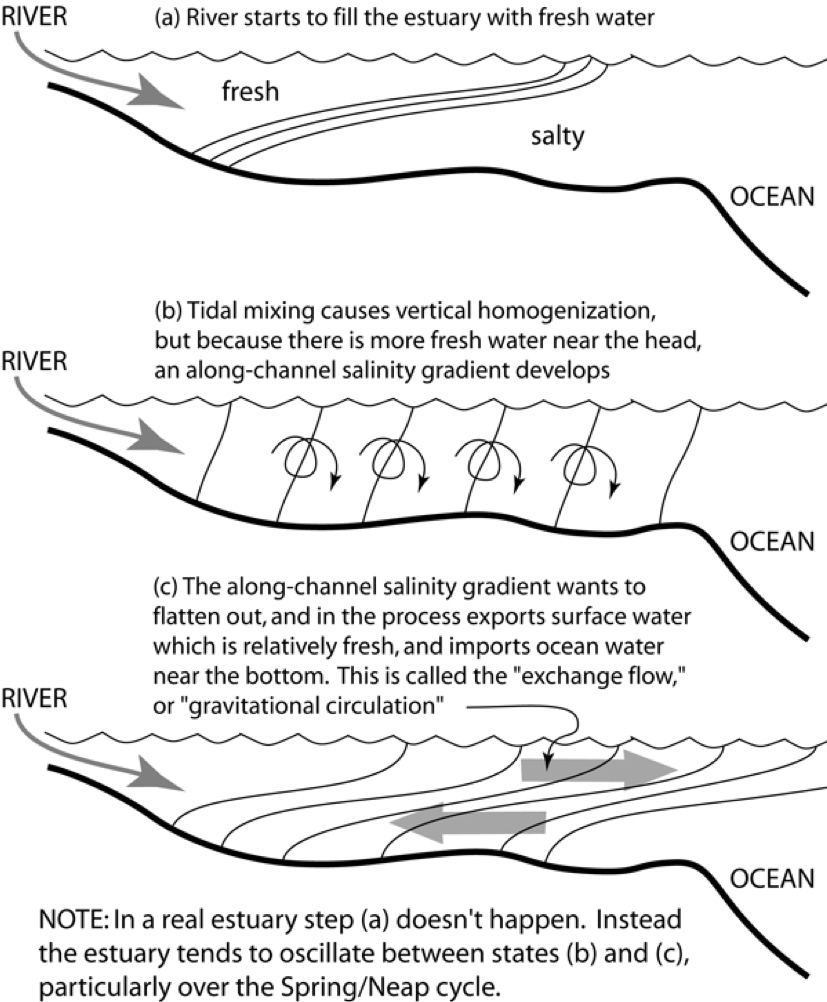
This energy usually comes from tidal currents. With these three ingredients: ocean water, river water, and tidal mixing, estuaries around the world perform a rather amazing trick - developing an "estuarine exchange flow" that persistently pulls ocean water in through the deeper part of the channel, and sends a mixture of ocean and river water back to the ocean in a surface flow. This exchange flow can often be surprisingly big - for example in Puget Sound it is 20 times bigger than the sum of all the rivers! This means that the exchange flow has a dominant influence over residence time and water quality in an estuary. Here we give an introduction to the physics behind the estuarine exchange flow.
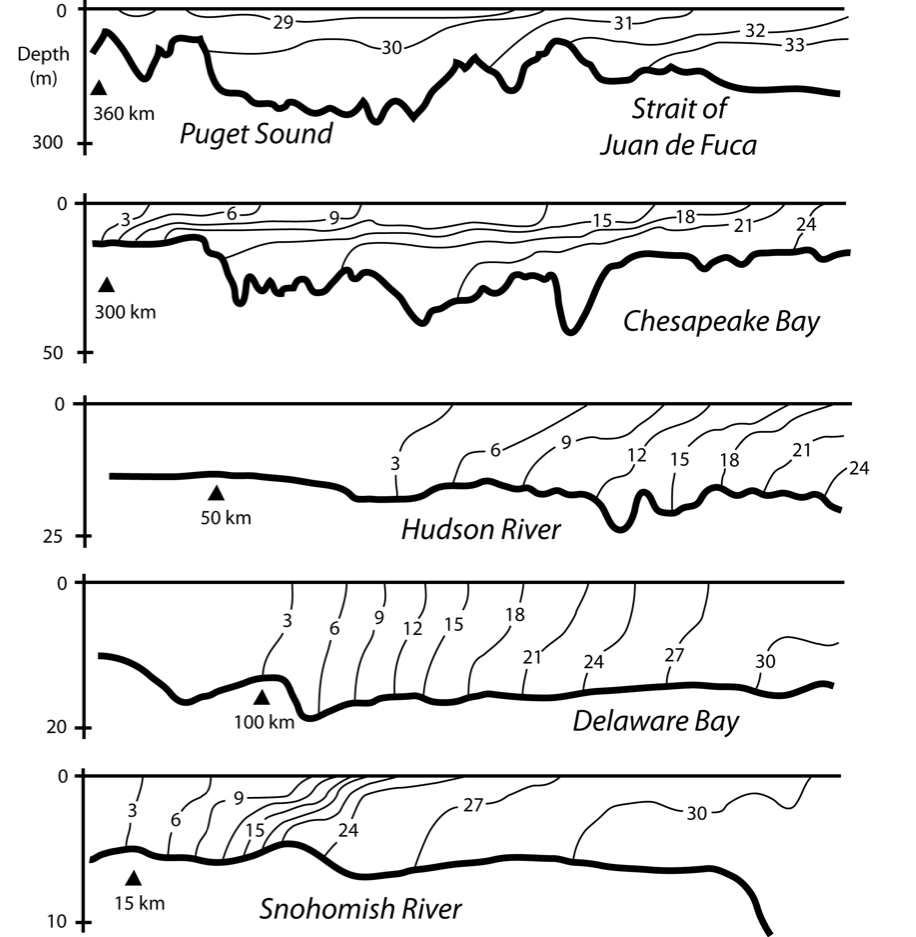
These plots show observed sections of salinity versus depth and along-channel distance for five different estuaries. The ocean is always on the right, and the river generally enters on the left. The numbers on the contours are salinity in "parts per thousand," so 30 means there are 30 kg of salt in 1000 kg of salty water. Salty water is denser than fresh water, and the force of gravity makes the salinity layers want to flatten out, just like the layers of oil and vinegar in salad dressing. If you look at the vertical and horizontal scales for each section you can see that they are very different, yet all of these systems share some similarities: they gradually get saltier from the river to the ocean end, and they have some vertical stratification (a lot for the Chesapeake, and only a little for its neighbor Delaware Bay). The stratification is important because it separates the surface water from the deep water. This allows for example for bottom water to become hypoxic (low in oxygen) even though surface waters might have a lot of oxygen.
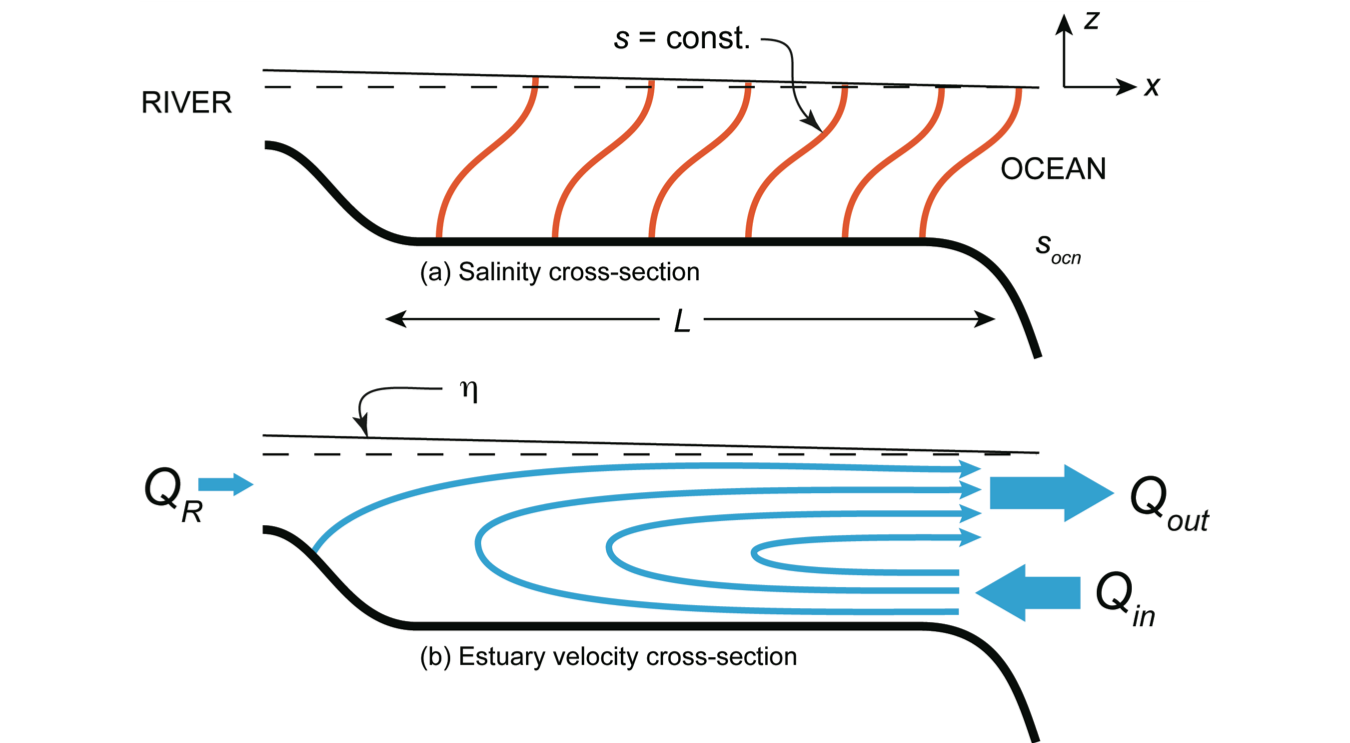
These plots show a conceptual sketch of estuarine salinity structure (top) and tidally averaged circulation (bottom). The salinity structure is just an idealized version of the observations from many estuaries, like the five we plotted above. The "circulation" shows that deep water is being pulled in from the ocean, and gradually rises up to join river water and flow back out to sea near the surface. The transports of these three flows are given by Qin, QR and Qout which are volume transports (cubic meters per second).
The circulation shown above is "tidally averaged" meaning that it is what we find after averaging over several tidal cycles. The tidal currents are often very strong, like 1 m/s sloshing back and forth, whereas the tidally averaged currents may be much smaller, like 0.1 m/s. What makes the tidally averaged currents so important it that they are persistent, always pulling deep water into the estuary, and sending surface water out.
Note on naming:
We call the tidally averaged circulation the "Estuarine Exchange Flow" because it efficiently exchanges water with the ocean. Typically Qin and Qout are several time larger than QR. In Puget Sound the annual average river flow QR is about 1000 m3/s, but Qin = 20,000 m3/s and Qout = 21,000 m3/s (note that the outflow is the sum of the two inflows).
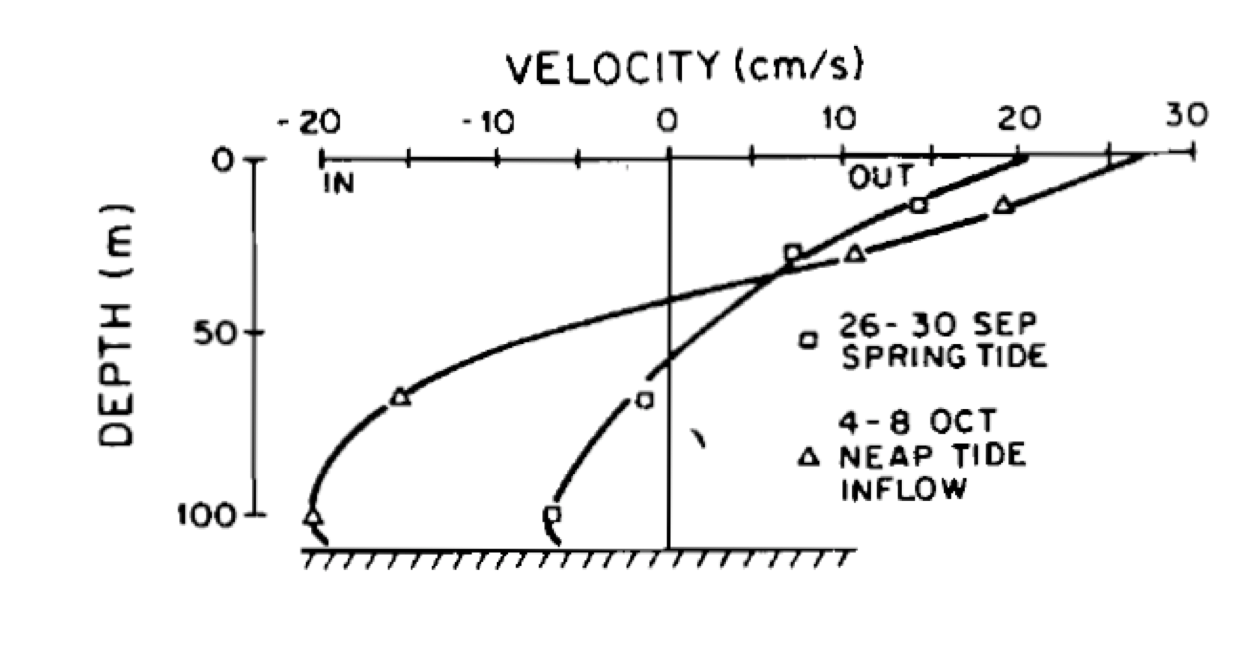
An example observation of the estuarine exchange flow is shown here. This shows tidally averaged currents versus depth at Admiralty Inlet, at the seaward end of Puget Sound. The negative currents in deeper water are the inflow, and the positive currents near the surface are the outflow. The profiles show greater exchange flow during neap tides when there are weaker tidal current. This is because the water is less turbulent then, and so there is less effective friction acting on the currents. These observations are from: Geyer, W. R., and G. A. Cannon, 1982: Sill processes related to deep water renewal in a fjord. J. Geophys. Res., 87, 7985-7996, a classic paper.
To learn more about the physics of the exchange flow here are couple of places to start: